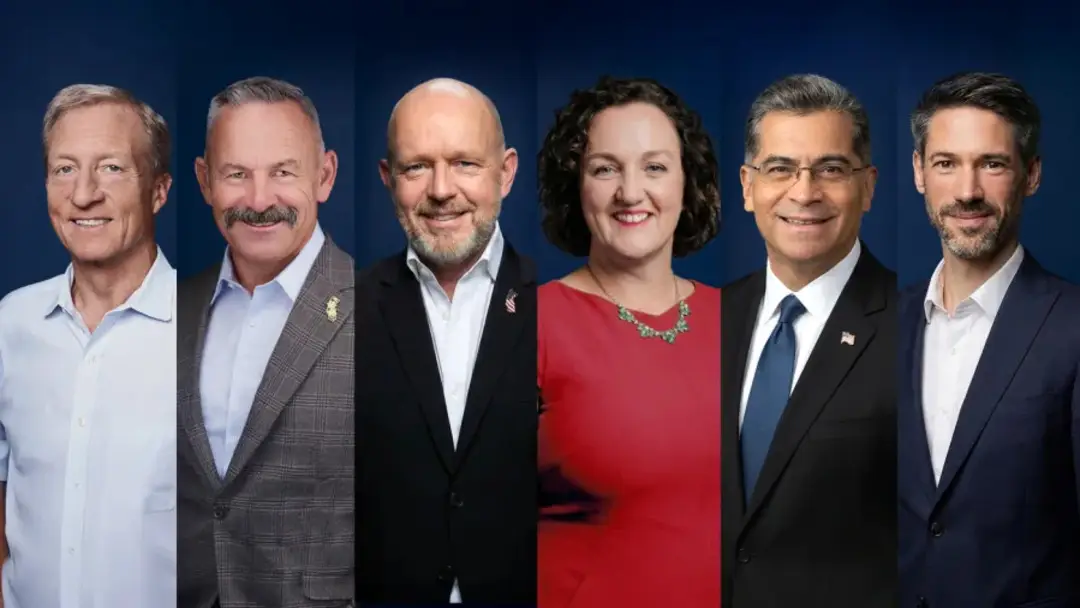
Six of California’s leading gubernatorial candidates faced off in a pivotal debate just weeks before the state’s primary election, offering voters one of the clearest comparisons yet in an increasingly unpredictable race. With no dominant frontrunner and a large share of undecided voters, the debate underscored both the competitiveness of the field and the complexity of the issues shaping California’s political future.
Held in San Francisco and broadcast statewide, the debate brought together candidates from both major parties, reflecting California’s unique “top-two” primary system, where the two highest vote-getters—regardless of party—advance to the general election.
The Candidates on Stage
The debate featured a mix of Democratic and Republican contenders, each attempting to define their vision for the state while distinguishing themselves from rivals.
| Candidate | Party | Background |
|---|---|---|
| Xavier Becerra | Democrat | Former U.S. Health Secretary and California Attorney General |
| Katie Porter | Democrat | Former congresswoman known for consumer advocacy |
| Tom Steyer | Democrat | Billionaire investor and climate activist |
| Matt Mahan | Democrat | San José mayor focused on urban policy |
| Steve Hilton | Republican | Former media personality and policy adviser |
| Chad Bianco | Republican | Riverside County sheriff |
This lineup reflects the ideological diversity within the race, ranging from progressive Democrats to conservative Republicans advocating systemic change.
Key Issues: Housing, Economy, and Cost of Living
The debate centered heavily on California’s most pressing challenges, particularly housing affordability, rising living costs, and economic inequality. Candidates broadly agreed that the state faces a crisis but differed sharply on how to address it.
Housing emerged as a dominant theme, with proposals ranging from increasing supply through development incentives to implementing stricter regulations on corporate ownership.
Economic concerns—especially high gas prices, insurance costs, and taxation—also featured prominently. Republican candidates emphasized reducing government spending and lowering taxes, while Democrats focused on targeted investments and regulatory reforms.
This divergence highlights a fundamental divide between competing visions for California’s economic future.
Policy Clashes and Strategic Messaging
While the debate remained relatively measured in tone, candidates used the platform to sharpen distinctions and challenge one another’s records.
Tom Steyer faced criticism over his past business investments, particularly in industries such as private prisons, despite positioning himself as a progressive reformer.
Xavier Becerra emphasized experience and institutional knowledge, portraying himself as a steady leader capable of navigating complex policy challenges. Meanwhile, Katie Porter focused on her independence from corporate funding, presenting herself as a candidate aligned with everyday Californians.
Matt Mahan attempted to position himself as a pragmatic alternative, criticizing both establishment politics and billionaire influence.
On the Republican side, Steve Hilton and Chad Bianco framed the state’s challenges as the result of long-term Democratic governance, advocating for structural change and policy overhaul.
A Race Without a Clear Leader
One of the most striking takeaways from the debate is the absence of a clear frontrunner. Polling suggests a fragmented electorate, with no candidate approaching a decisive lead and a significant portion of voters still undecided.
This uncertainty creates a volatile political environment. In California’s primary system, even modest shifts in support could determine which candidates advance to the general election.
The departure of former candidate Eric Swalwell has further reshaped the race, redistributing support and intensifying competition among remaining contenders.
The Risk of Vote Splitting
For Democrats, the crowded field presents a strategic risk. With multiple candidates appealing to similar voter bases, there is concern that vote splitting could allow two Republican candidates to advance to the general election—a scenario that would significantly alter the political dynamics of the race.
This possibility has prompted discussions within party circles about consolidation, though no clear consensus has emerged.
The situation underscores how electoral systems can shape outcomes, particularly in competitive and fragmented races.
Performance Without a Breakout Moment
Despite the high stakes, analysts noted that the debate did not produce a defining or transformative moment. While candidates effectively articulated their positions, none delivered a performance that decisively reshaped the race.
This outcome reinforces the notion that the election remains highly fluid, with voters still evaluating their options and campaigns continuing to evolve.
In such an environment, momentum may be driven less by single events and more by sustained messaging, endorsements, and voter outreach.
Broader Implications for California Politics

The debate reflects deeper structural challenges facing California. Issues such as housing shortages, homelessness, economic inequality, and infrastructure constraints are not easily resolved, requiring long-term policy solutions and political consensus.
These challenges are part of a broader discussion around state-level governance challenges, where large and diverse states must balance competing priorities while maintaining economic stability.
The next governor will inherit not only a complex policy landscape but also a politically divided electorate.
What Voters Should Watch Moving Forward
As the primary election approaches, several factors will be critical in determining the outcome:
- Whether a candidate can consolidate support within their party
- How undecided voters break in the final weeks
- The impact of campaign funding and endorsements
- Voter turnout across different regions and demographics
These dynamics will shape not only the primary results but also the broader trajectory of the race.
For broader context on the debate and its implications, the California governor debate candidates coverage provides further detail from a regional political source.
Conclusion: A Contest Still Wide Open
The debate among California’s six leading gubernatorial candidates highlighted both the stakes of the upcoming election and the uncertainty that defines it. With no clear frontrunner and multiple viable contenders, the race remains one of the most competitive in recent state history.
While the debate clarified policy positions and candidate differences, it ultimately reinforced a central reality: the outcome remains highly unpredictable.
As voters move closer to the primary, the decisions made in the coming weeks will determine not only who advances but also the direction of California’s leadership at a critical moment.