

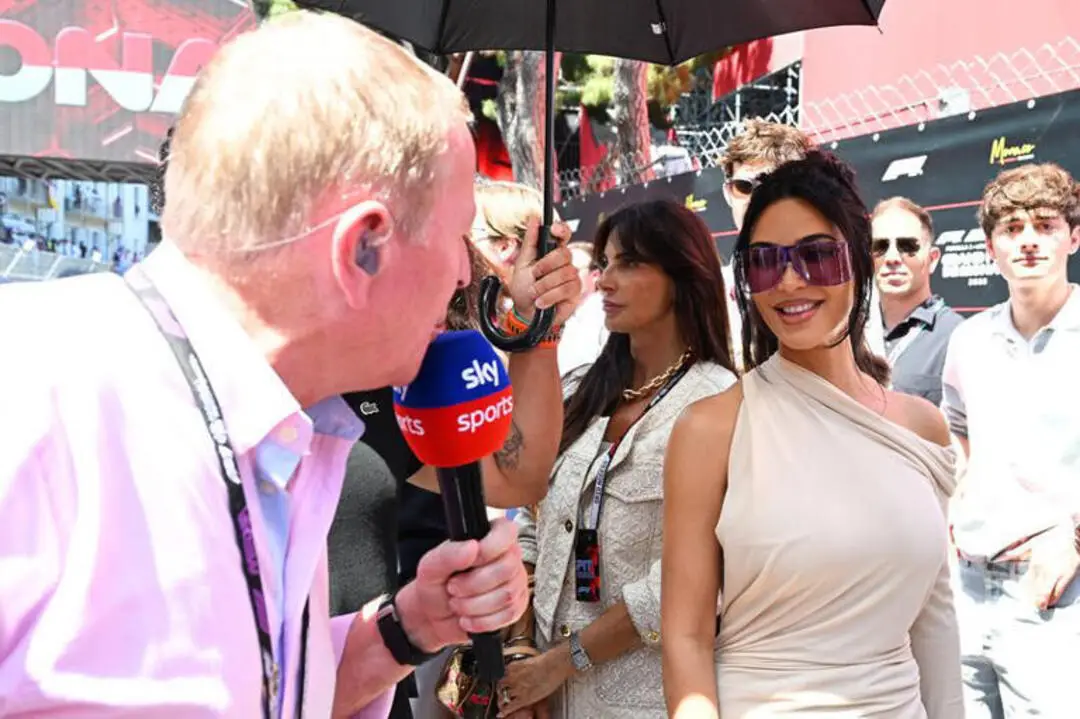
The Kim Kardashian Monaco Grand Prix backlash was never only about one awkward exchange on a crowded F1 grid. It became a test of how Formula 1 handles celebrity attention when long-time fans feel the sport’s own rituals are being pushed into the background.
For readers following the collision of celebrity culture and sports headlines, the Monaco debate shows how quickly a short clip can become a larger argument about access, etiquette, and respect. Kardashian’s appearance drew attention because Monaco is already F1’s most glamorous stop, but the criticism grew when fans accused her of brushing off the kind of pre-race interaction that has become part of the sport’s television identity.
Kim Kardashian Monaco Grand Prix Backlash Was About More Than One Clip
The strongest reaction centered on an apparent grid-walk snub involving Sky Sports F1 broadcaster Martin Brundle. His pre-race grid interviews are known for their unpredictability, especially at celebrity-heavy races where security teams, publicists, drivers, officials, and VIP guests all move through the same narrow space.
Kardashian’s critics framed the moment as disrespectful because Brundle is not just another reporter trying to chase a viral quote. He is a former F1 driver and one of the sport’s most recognizable broadcast figures. For many fans, refusing even a quick exchange felt like a guest entering F1’s most visible stage without acknowledging one of its familiar customs.
That reaction says as much about Formula 1’s audience as it does about Kardashian. F1 fans are unusually protective of tradition, especially at Monaco, where glamour is accepted but still expected to orbit the race rather than replace it.
The Towel Moment Made The Story Easier To Mock
The controversy did not stay limited to the grid-walk exchange. A separate post-race clip involving a towel added a lighter but more viral layer to the criticism, with fans joking that Kardashian had walked into another piece of race-day etiquette without realizing it.
That second moment mattered because it gave social media a cleaner visual joke. The grid-walk clip required interpretation: Did she hear the question? Was security moving her along? Was she simply not interested in speaking? The towel clip was easier to reduce into a meme.
That is how modern sports controversy often works. The first moment creates the argument. The second moment creates the punchline. Once the internet has both, the story becomes harder to control.
Why The Monaco Grid Makes Celebrity Behavior Look Bigger
The Monaco Grand Prix is not a normal race weekend. The setting is tighter, richer, more photographed, and more socially loaded than most stops on the calendar. Every gesture looks amplified because cameras are everywhere and the grid itself feels like a moving red carpet.
That is why a few seconds can become a story. A celebrity may see the grid as a busy walkway. F1 fans see it as privileged race space, close to drivers, cars, engineers, and the final pre-race tension before lights out.
Kardashian’s presence also landed during a race with real sporting weight. The official Monaco race result listed Kimi Antonelli as the winner, Lewis Hamilton second, and Isack Hadjar third. That competitive context matters because the celebrity conversation risked pulling attention away from a major race result.
The Reaction Split Between F1 Purists And Celebrity Defenders
Not every response treated Kardashian as the villain. Some fans argued that celebrities are not required to stop for interviews, especially in a chaotic environment. Others pointed out that public figures often move with handlers and security, making brief encounters look colder than they may actually be.
Still, the backlash became a useful snapshot of the tension inside modern F1. The sport has gained a broader global audience, helped by entertainment coverage, celebrity attendance, and lifestyle branding. But that growth also creates friction with fans who want the race, drivers, and paddock culture to remain central.
| Pressure Point | Why It Matters |
|---|---|
| Grid-walk etiquette | Fans see it as part of F1’s live broadcast culture |
| Celebrity access | VIP guests can dominate attention without adding race insight |
| Social media clips | Short moments can define an entire race-weekend narrative |
| Monaco’s status | The race already blurs sport, luxury, and spectacle |
| Fan loyalty | Long-time viewers resist feeling pushed aside by celebrity coverage |
The split is not new, but Kardashian’s appearance made it sharper. She is one of the few celebrities famous enough to become the story simply by standing in the wrong place at the wrong time.
Brundle’s Reaction Made The Snub Feel Harder To Dismiss
Martin Brundle’s role in the backlash mattered because fans saw the moment as more than a missed celebrity interview. Brundle has become part of Formula 1’s race-day rhythm, and his grid walks depend on brief, unscripted exchanges with people inside the sport’s most exclusive space. That is why the Kardashian moment felt difficult for many viewers to forgive. It was not simply that she moved past a broadcaster; it looked, to critics, like a high-profile guest failing to recognize one of F1’s most familiar voices on one of its biggest stages.
The Next Signal Is How F1 Manages Its Celebrity Stage
The issue for Formula 1 is not whether celebrities should attend races. They always have, and Monaco has built part of its mythology around that mix of racing, royalty, fashion, wealth, and entertainment.
The real question is how the sport protects its own broadcast traditions while welcoming guests who may not understand them. Brundle’s grid walk works because it is unpredictable, but that unpredictability also depends on some shared understanding that people on the grid might be approached.
Sky’s race coverage showed how the sporting result still had enough drama to stand on its own, with Monaco GP coverage focused on Antonelli’s win and Hamilton’s second-place finish. But when the celebrity subplot outpaces the race conversation, F1 has a presentation problem.
That does not mean tighter rules are the answer. It may simply mean clearer expectations for guests, security teams, and broadcasters. The grid cannot become a celebrity tunnel where the sport itself feels secondary.
Kim Kardashian Monaco Grand Prix Story Shows F1’s New Balancing Act
The Kim Kardashian Monaco Grand Prix backlash will likely fade faster than the race result, but the argument behind it will return. Every major sports league now wants celebrity reach, social media attention, and crossover audiences. The risk is that core fans can start to feel like the event is being repackaged for people who do not care about the competition.
Kardashian did not need to deliver expert race analysis. She did not need to perform for F1 fans on command. But at Monaco, where access is symbolic and tradition carries weight, even a small public interaction can be judged as a sign of respect or indifference.
That is why the moment stuck. It gave F1 fans a simple question to argue over: when a global celebrity steps onto one of motorsport’s most protected stages, should the sport adjust around the celebrity, or should the celebrity understand the room?


