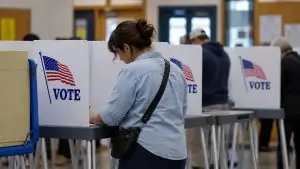
Democrats have won control of both chambers of Congress in the November 3 midterm elections, reshaping Washington’s balance of power while President Donald Trump remains in the White House. The 2026 midterm election results create a divided government in which Democrats can challenge presidential priorities, investigate federal agencies, and influence national spending—but cannot simply turn their agenda into law.
The central question is how aggressively Congress will use its new authority when the 120th Congress begins in January 2027.
2026 Midterm Election Results Shift Control of Washington
Democrats secured enough victories to take the House of Representatives and Senate away from Republican control, ending the party’s unified hold on Congress and the presidency.
According to the latest congressional election results, Democrats gained seats across competitive districts and states, including several areas that previously supported Republicans.
The party’s victories came amid voter frustration over living costs, inflation, and the Trump administration’s performance.
Those economic concerns had already become central to the campaign, as reflected in earlier coverage of Republican candidates distancing themselves from Trump.
Although several individual races were still being counted on November 4, Democratic control of both chambers had been projected.
That distinction matters because election-night projections determine the expected balance of power before every result receives official certification.
The incoming Democratic majorities will gain control of committee leadership, legislative scheduling, and congressional oversight priorities.
However, congressional control does not equal presidential control. Trump retains executive authority, including the power to veto legislation passed by Congress.
Democratic Majorities Gain Leverage Over Federal Spending
Federal spending could become one of the most consequential areas of conflict between congressional Democrats and the White House.
Congress holds constitutional authority over federal appropriations. Lawmakers determine how much money agencies may spend through legislation that must complete the federal lawmaking process.
With majorities in both chambers, Democrats will be positioned to shape annual spending bills, negotiate funding limits, and challenge budget requests from the administration.
They could pursue different funding priorities for healthcare, education, housing, infrastructure, or federal enforcement programs.
However, those proposals would still require agreement between the House and Senate before reaching the president.
Trump could reject spending legislation he opposes, creating pressure for compromise.
The possibility of a government shutdown would become particularly significant if lawmakers and the White House cannot agree on funding before an applicable deadline.
Spending negotiations become a pressure point because both parties must consider the political and practical consequences of delayed federal funding.
Democrats could also use appropriations hearings to demand explanations of agency spending decisions.
Yet congressional funding authority has limits. Existing laws, mandatory spending requirements, and constitutional restrictions can narrow lawmakers’ options.
For Americans, the immediate implications could involve federal services, program funding, and the stability of government operations.
Congressional Investigations Could Intensify Under Democratic Leadership
Control of Congress also changes who decides which government activities receive formal scrutiny.
Democratic committee chairs could initiate investigations into federal spending, administrative decisions, regulatory enforcement, and executive-branch conduct.
Potential subjects include government contracts, immigration enforcement, presidential actions, and the administration’s handling of federal programs.
Committees may request documents, hold public hearings, question administration officials, and issue subpoenas within their lawful authority.
These tools allow Congress to examine executive decisions even when lawmakers cannot directly reverse them.
Oversight authority is separate from lawmaking power, making investigations particularly important under divided government.
Congressional investigations do not automatically establish wrongdoing. Evidence must be examined, witnesses may challenge allegations, and disputes over documents can result in litigation.
The White House may also assert executive privilege or contest certain demands for information.
Another possibility is impeachment proceedings.
The House has the constitutional authority to impeach federal officials, including the president, while the Senate conducts impeachment trials.
Conviction and removal require support from two-thirds of senators present.
A Democratic majority alone would not satisfy that threshold.
Consequently, oversight investigations may produce hearings, reports, legislative proposals, or political disputes without necessarily resulting in criminal findings or removal from office.
What Democrats Can Change—and What Trump Can Still Block
The new balance of power creates different opportunities and limitations depending on the action Congress attempts.
| Congressional power | What Democrats can do | Main limitation |
|---|---|---|
| Federal spending | Develop and pass funding proposals | Presidential signature or veto override generally required |
| Investigations | Hold hearings and seek documents | Legal challenges and executive privilege disputes |
| Legislation | Advance bills through both chambers | Presidential veto and Senate procedural rules |
| Presidential appointments | Senate can reject or delay nominees | Executive retains nomination authority |
| Impeachment | House can approve articles of impeachment | Senate conviction requires a two-thirds vote |
The most significant limitation remains the presidential veto.
Under the Constitution, legislation normally requires presidential approval or sufficient congressional support to overcome a rejection.
The constitutional veto override procedure requires two-thirds of members voting in each chamber, provided a quorum is present.
That is considerably higher than the ordinary majority needed to pass most legislation in the House.
Senate procedural rules introduce another obstacle. Many bills can face a filibuster, with 60 votes generally needed to end debate under existing rules.
Consequently, even Democrats controlling both chambers may need Republican support to advance significant legislation.
The Senate’s authority over presidential appointments provides a different form of leverage.
Democratic senators could reject or delay certain executive and judicial nominees, although confirmation rules differ from those governing ordinary legislation.
A veto-proof majority is not guaranteed simply because one party controls Congress.
Successful legislation may therefore depend on negotiations involving both parties and the White House.
Spending Deadlines and Senate Rules Will Test the New Majorities
The first major test will come when the newly elected Congress takes office on January 3, 2027.
Democratic leaders will need to establish committee assignments, legislative priorities, and strategies for negotiating with the administration.
Budget deadlines, confirmation hearings, and investigations could quickly determine the relationship between Congress and Trump.
Another pressure point will be whether Democrats pursue legislation intended to attract bipartisan support or concentrate on measures the president is likely to reject.
Trump, meanwhile, can continue exercising executive powers within constitutional and statutory limits.
Court rulings may also shape disputes involving administrative authority and congressional oversight.
The coming months will reveal whether divided government produces negotiated legislation, prolonged institutional conflict, or a combination of both.
For voters, the distinction between legislative proposals and enacted policy will be essential.
A bill passing Congress does not automatically become law, and a congressional investigation does not establish that an official violated the law.
The 2026 midterm election results have fundamentally changed Washington’s political structure, but the next Congress will determine how that shift translates into government action.
Democrats now have the authority to scrutinize the administration, influence spending decisions, and set congressional priorities. Their central challenge will be converting those powers into practical outcomes while navigating presidential vetoes, Senate rules, and the continuing authority of the executive branch.