

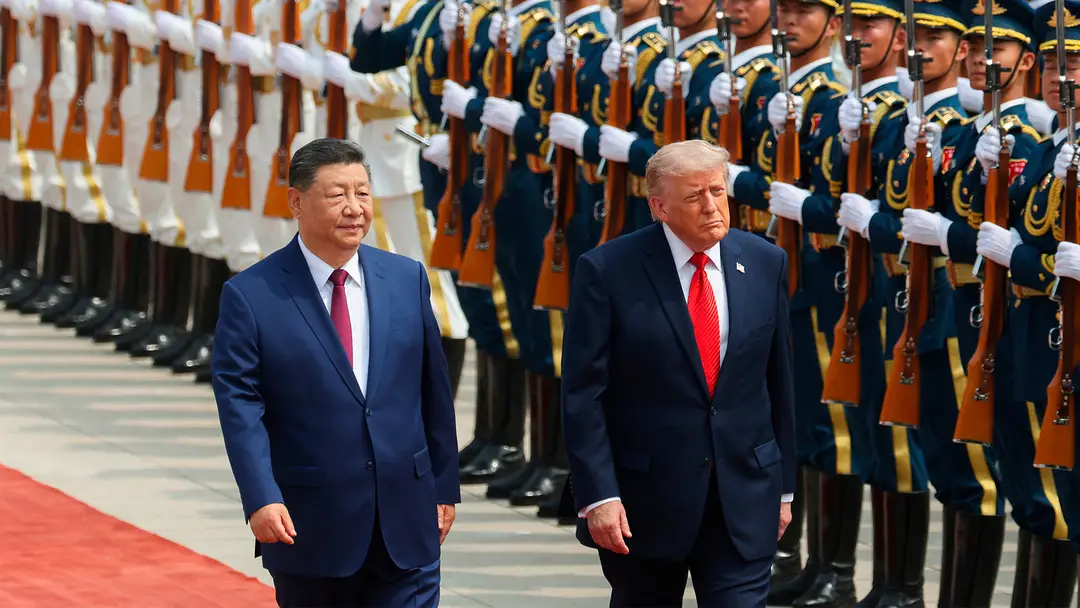
The Trump China visit opened with ceremony, flags, handshakes, and carefully staged warmth, but the message behind the pageantry was unmistakably colder. President Donald Trump arrived in Beijing for high-stakes talks with Xi Jinping at a moment when Taiwan, Iran, trade, artificial intelligence, and global energy security have all become part of the same strategic contest.
What made the visit so revealing was the contrast. China offered the optics of respect, yet Xi used the meeting to warn that mishandling Taiwan could push the world’s two largest powers toward direct conflict. That is why this summit matters beyond the photographs: it showed how much diplomacy can soften the surface while leaving the hard power struggle intact.
Why The Trump China Visit Matters Now
The Trump China visit matters because it came at a moment when Washington needed more than symbolism from Beijing. The United States wanted China’s cooperation on Iran, reassurance on energy flows, possible openings on trade, and some degree of restraint around Taiwan. China, meanwhile, wanted recognition of its status, limits on U.S. pressure, and a chance to define the relationship on terms more favorable to Beijing.
That combination made the summit unusually layered. It was not only a bilateral meeting. It was a test of whether Trump’s personal diplomacy with Xi could produce practical movement on issues that have become increasingly difficult to separate. Taiwan affects military planning. Iran affects oil and global shipping. Trade affects inflation and manufacturing. Artificial intelligence affects national security. Rare earths and advanced chips affect the future balance of technological power.
The public frame around the Trump China visit captured the tension clearly: Trump arrived to an elaborate welcome while the agenda waiting behind closed doors was crowded with risk. A warm airport scene did not erase the fact that both governments entered the meeting carrying competing demands.
The central issue is leverage. Trump wanted Beijing’s help on problems that Washington could not solve alone. Xi wanted to show that China would cooperate only from a position of strength. That dynamic shaped everything.
The Warm Welcome Was Part Of The Strategy
China understands ceremony. The welcome given to Trump was not accidental hospitality; it was a diplomatic instrument. Grand arrivals, military honors, choreographed greetings, and polished state imagery are designed to send messages to several audiences at once. They tell the visitor that China values respect. They tell the domestic audience that Beijing is receiving a major world leader on its own terms. They tell the world that China remains central.
Trump is unusually responsive to personal diplomacy and ceremonial scale. Xi knows that. A generous welcome can create a favorable atmosphere before harder conversations begin. It can also encourage Trump to emphasize personal rapport even when substantive disagreements remain unresolved.
That does not make the ceremony meaningless. Diplomatic tone matters. A respectful welcome can create space for discussion. It can reduce immediate hostility. It can signal that both sides still want a channel open. But ceremony should not be mistaken for settlement.
The key word is theater. In diplomacy, theater can be useful, but it can also distract. A state dinner does not resolve Taiwan. A warm greeting does not reopen stalled trade negotiations. A public smile does not guarantee private concession.
Xi’s Cold Warning On Taiwan Changed The Mood
The core warning came on Taiwan. Xi’s message was that Taiwan remains the most sensitive and dangerous issue in U.S.-China relations. Chinese statements have long framed Taiwan as a sovereignty matter, but the warning during this summit carried special weight because it was delivered directly in the context of Trump’s visit.
The phrasing reported from Chinese accounts emphasized that Taiwan independence and peace across the strait are incompatible. That is not diplomatic filler. It is a hard red line. Xi was telling Trump that if Washington strengthens support for Taiwan in ways Beijing sees as encouraging independence, China may respond with more than rhetoric.
The issue is deterrence. Washington wants to deter China from using force against Taiwan. Beijing wants to deter Taiwan from moving further away from China and deter Washington from deepening military or political support. Both sides are trying to shape the choices of others, and that makes miscalculation dangerous.
Taiwan also exposes the limits of personal rapport. Trump may praise Xi, and Xi may welcome Trump warmly, but neither leader can simply wish away the strategic reality. Taiwan is a democratic, self-governing island that Beijing claims as its own. The United States maintains a policy of strategic ambiguity while supporting Taiwan’s self-defense. That architecture is fragile because each side interprets the other’s moves through suspicion.
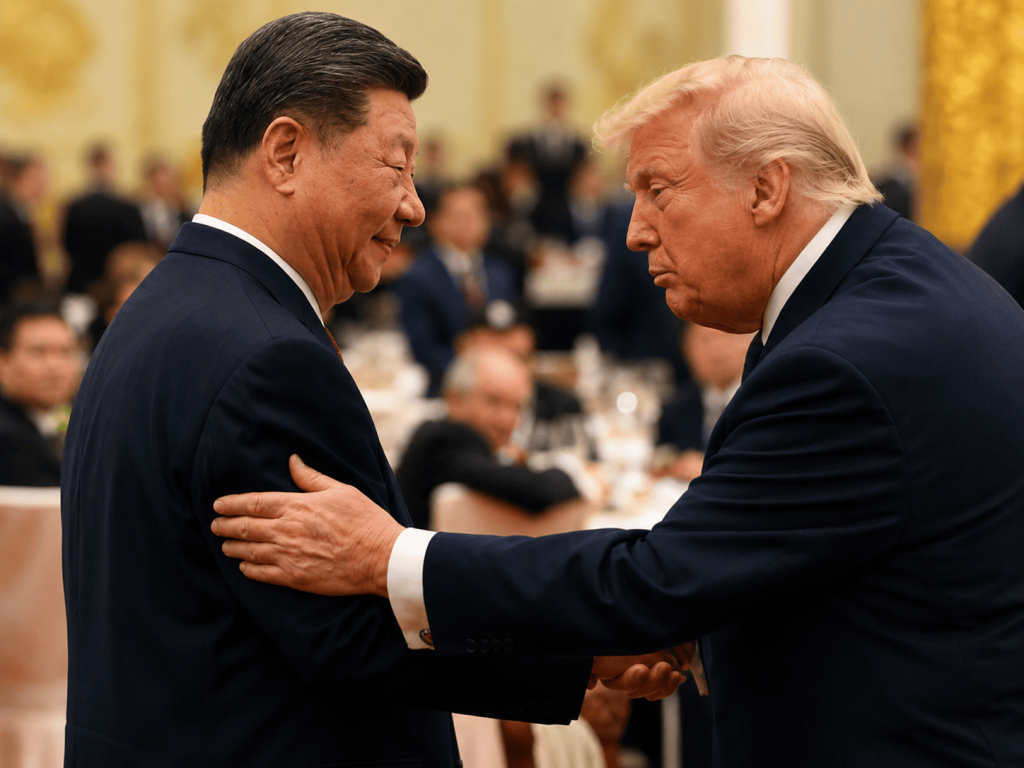
Why Taiwan Overshadowed The Summit’s Softer Language
Both governments may prefer language about stability, cooperation, and constructive relations. Those phrases are useful because they reduce immediate pressure and provide diplomatic cover for further talks. Yet Taiwan sits underneath every softer phrase as the hardest test.
If China believes the U.S. is encouraging Taiwan independence, the relationship can deteriorate rapidly. If the U.S. believes China is preparing coercion or invasion, Washington may increase military support. If Taiwan believes U.S. backing is weakening, its own political calculations may shift. These three moving parts make Taiwan a permanent source of tension.
That is why Xi’s warning mattered more than any friendly public exchange. Leaders can agree to pursue stability, but stability requires restraint on the issue most likely to produce war. Without that restraint, the language becomes decorative.
The risk is not only intentional conflict. It is accident, escalation, or misunderstanding. Military aircraft, naval patrols, cyber operations, sanctions, arms sales, political visits, and public statements can all become signals. When both sides are primed to read signals negatively, even routine moves can generate disproportionate responses.
Iran Made The Meeting More Complicated
Trump also arrived in China needing Beijing’s help on Iran. That is a difficult ask. China has economic and strategic interests in the Middle East, including energy security and ties with Iran. It also has an interest in preventing a wider war that could disrupt oil flows. Yet Beijing is unlikely to help Washington in ways that simply strengthen U.S. leverage without benefiting China.
This is where the internal link to the wider regional crisis matters. The Trump administration’s posture toward Tehran, including its Iran escalation strategy, placed additional pressure on the China talks because Beijing’s influence with Iran became more valuable as the conflict intensified.
China may support keeping energy routes open, including the Strait of Hormuz, because a severe disruption would damage its own economy. But support for open shipping does not automatically translate into full alignment with Washington. Beijing can oppose disruption while still criticizing U.S. military pressure. It can call for stability while avoiding commitments that look like partnership with Trump against Tehran.
That ambiguity is strategic discipline from China’s perspective. It allows Beijing to appear responsible without sacrificing leverage over either side.
Trade Remained The Familiar Friction Point
Trade was always going to be part of the visit. The U.S.-China economic relationship remains one of the world’s most consequential, but also one of the most politically sensitive. Tariffs, market access, farm purchases, export controls, subsidies, supply chains, and industrial policy all sit inside the same unresolved dispute.
Trump likely wanted visible progress that could be sold as a win: purchases of U.S. goods, commitments on energy, openings for American companies, or cooperation on fentanyl-related controls. China likely wanted relief from pressure, especially around technology restrictions and broader trade hostility.
The difficulty is that neither side trusts the other’s economic model. Washington sees China’s state-backed industrial strategy as unfair and strategically threatening. Beijing sees U.S. restrictions as containment disguised as trade policy. That creates a cycle where every concession feels risky.
The economic table is useful here.
| Issue | U.S. Priority | China’s Likely Concern |
|---|---|---|
| Trade access | More purchases and market openings | Avoiding one-sided concessions |
| Advanced chips | Limiting China’s military and AI gains | Reducing U.S. technology pressure |
| Rare earths | Securing critical supply chains | Preserving strategic leverage |
| Fentanyl controls | Disrupting precursor chemical flows | Avoiding blame for U.S. drug problems |
| Energy purchases | Supporting U.S. producers and lowering tension | Securing reliable supply without political dependence |
| Taiwan | Maintaining deterrence and self-defense support | Blocking perceived moves toward independence |
The table shows why a breakthrough was always difficult. Each issue is connected to something larger than commerce. Trade now carries national-security meaning, and that makes compromise harder.
Technology And AI Raised The Stakes
Artificial intelligence and advanced semiconductors are no longer side issues in U.S.-China relations. They are central to military modernization, surveillance, economic competitiveness, and future geopolitical power. That means any summit between Trump and Xi must address technology even when the public conversation focuses on trade or war.
The United States has sought to limit China’s access to advanced chips and related technology that could support military or AI capabilities. China views those limits as an attempt to hold back its rise. The dispute is not going away because both sides see the same technologies as strategically decisive.
This is where power becomes embedded in supply chains. A chip export rule may look technical. A rare earth restriction may look commercial. In reality, both are instruments of statecraft. Each side is trying to shape the other’s future capacity.
The Trump China visit therefore carried a deeper message: the old economic relationship cannot simply be restored. Even if both leaders prefer better business ties, the security state on each side is now deeply involved. Companies want access. Governments want control. That tension will define the next phase.
Why Trump’s Personal Diplomacy Has Limits
Trump has long presented personal relationships with foreign leaders as a central tool of diplomacy. He often emphasizes chemistry, respect, flattery, and direct negotiation. With Xi, that style can create moments of apparent warmth. But personal diplomacy has limits when the underlying interests are this far apart.
The advantage of Trump’s style is that it can break through bureaucratic stagnation. A leader-to-leader exchange can move an issue that lower-level talks could not. It can create momentum. It can signal political permission for negotiators to explore a deal.
The weakness is dependence on personality. If the relationship becomes the main mechanism, policy can become unstable. A warm meeting may produce optimism without durable structure. A cold exchange may trigger overreaction. Strategic competition cannot be managed only through leader chemistry.
Xi is a disciplined counterpart. He may welcome Trump warmly, praise cooperation, and still hold firm on Taiwan, technology, and China’s core interests. That is the point. Personal rapport can improve the atmosphere, but it cannot erase the strategic map.
China’s Message Was Aimed Beyond Trump
Xi’s warning was not only for Trump. It was also for Taiwan, U.S. allies, Chinese citizens, and the wider international audience. Beijing wanted to show that even during a friendly-looking summit, it would not soften its position on sovereignty.
For Taiwan, the message was meant to warn against further movement away from Beijing’s preferred outcome. For U.S. allies, it was meant to show that China will press hard on core interests. For the Chinese public, it reinforced Xi’s image as a leader who can host America’s president without yielding on national unity.
This layered messaging is a form of governance. Authoritarian diplomacy often serves domestic legitimacy as much as foreign policy. The images of Trump being welcomed in Beijing helped demonstrate China’s status. The warning on Taiwan helped demonstrate resolve.
That combination is powerful. Warmth shows confidence. Warning shows control. Together, they allow Beijing to project maturity without appearing weak.
The Market And Business Audience Was Watching Closely
The business audience watched the visit for signs of reduced friction. American executives, investors, manufacturers, technology firms, agricultural exporters, and energy companies all have reasons to care about U.S.-China stability. Even modest improvements can affect planning, investment, and market sentiment.
Yet business optimism has to be careful. A warm summit does not end structural competition. Companies may welcome improved tone, but they still face tariffs, export controls, data rules, supply-chain risk, sanctions exposure, and political scrutiny in both countries.
The word that matters is predictability. Businesses can handle difficult rules better than unpredictable ones. A hostile but clear environment may be easier to manage than a friendly-looking environment that changes abruptly. If the summit produces clearer channels, that helps. If it produces only ceremony, the business benefit is limited.
The China summit talks showed how quickly optimism can collide with hard issues. Warm words may support markets for a day, but trade and technology disputes require detailed agreements, not atmospherics.
What The Visit Means For U.S. Allies
U.S. allies in Asia and Europe will examine the visit carefully. They want reduced U.S.-China tension because conflict would be economically and militarily dangerous. But they also worry about any U.S.-China arrangement that appears to trade away allied concerns.
Taiwan will watch most closely. Japan, South Korea, Australia, the Philippines, and European governments will also study the language around Taiwan, trade, and technology. They need to know whether Trump is strengthening deterrence, softening it, or managing the issue through personal understandings that may not be visible.
The allied concern is clarity. Ambiguity can be useful in Taiwan policy, but allies still need confidence that Washington understands the risks. If Trump appears too deferential to Xi, allies may worry. If he appears too confrontational, they may fear escalation. The balance is delicate.
This is why summits with China are never only bilateral. Every line is read across capitals. Every gesture becomes a signal. Every omission can create anxiety.
The Iran And Hormuz Question Gave China More Leverage
The Iran conflict strengthened China’s position during the visit. When Washington needs Beijing’s help to reduce Middle East risk, China gains bargaining space. It can ask what the United States is willing to offer in return, or it can provide limited cooperation while preserving its broader relationship with Tehran.
This does not mean China wants chaos. Beijing relies heavily on stable energy flows. A major disruption around Hormuz would hurt China as much as anyone. But China may prefer a solution that reduces energy risk while also constraining U.S. military freedom.
That is a subtle but important distinction. China wants stability, but not necessarily a U.S.-led stability that reinforces American dominance. It wants influence in shaping the outcome.
That gives Xi additional leverage. Trump’s need for help on Iran may make him more cautious on other issues, including Taiwan and trade. Whether that happened in substance is hard to judge from public statements, but the strategic pressure was clearly present.
What Was Missing From The Warm Optics
The missing piece was a major breakthrough. Ceremonial warmth can create the impression of progress, but meaningful policy change requires specifics. Were there enforceable trade commitments? Was there a concrete China pledge on Iran? Was there measurable progress on fentanyl controls? Was there a new channel for Taiwan crisis management? Were technology disputes narrowed?
Without specifics, the visit may be remembered as more symbolic than substantive. Symbolism has value, especially when relations are tense. But symbolism does not lower tariffs, secure shipping routes, prevent conflict over Taiwan, or settle AI export rules.
The gap between image and outcome is the central risk. If the public is told that the relationship improved dramatically while the underlying conflicts remain unresolved, disappointment may follow. If markets price in too much progress, volatility can return quickly.
A summit should be judged by what changes after the leaders leave the room. Do negotiators meet again? Do military channels improve? Do trade teams draft enforceable terms? Do both sides reduce provocative moves? That is where success becomes measurable.
Why The Visit Still Had Value
Even without a major breakthrough, the visit had value because high-level contact reduces the danger of drift. When two great powers stop talking, misunderstandings multiply. A summit can reestablish channels, clarify red lines, and identify areas where limited cooperation is possible.
That is especially important in a period of overlapping crises. Iran, Taiwan, AI, trade, and energy security all require communication. Neither country can fully isolate one issue from another anymore. A breakdown in one area can spill into others.
The visit also gave both leaders a chance to test each other’s priorities. Trump could assess how far Xi might go on Iran or trade. Xi could assess how Trump views Taiwan, technology limits, and economic pressure. That kind of direct reading matters.
The practical value is communication. It is not glamorous, but it can prevent errors. In great-power politics, preventing the worst outcome can be as meaningful as achieving a dramatic agreement.
What Readers Should Watch Next
Readers should watch the follow-up, not only the summit. The most important developments will come after the cameras leave Beijing. Do trade teams announce detailed negotiations? Do Chinese energy or agricultural purchases materialize? Does Beijing provide any practical help on Iran? Does Washington maintain Taiwan support without provoking a new crisis? Do both sides reopen or strengthen military communication channels?
The Taiwan language deserves special attention. If China increases military pressure around the island after the summit, the warm optics will look shallow. If the U.S. adjusts arms sales or political messaging, allies will study the change closely. If both sides reduce tension while maintaining positions, the summit may have helped stabilize the issue temporarily.
The Iran track also matters. If China helps keep energy routes open or pressures Tehran to avoid wider escalation, Trump may claim a diplomatic win. If Beijing remains vague, the summit may expose the limits of U.S. influence over China.
The right lens is evidence. Not tone. Not applause. Not pageantry. Evidence.
The Forward View On The Trump China Visit
The Trump China visit matters now because it revealed the central paradox of U.S.-China diplomacy: both sides want stability, but neither side wants to give up leverage. Trump received a warm welcome, yet Xi delivered a cold warning. The ceremony suggested partnership. The substance exposed strategic competition.
That is not a failure by itself. Great powers often manage conflict through a mix of respect, pressure, and restraint. The danger comes when the imagery creates false confidence. Taiwan remains volatile. Iran remains a test of Chinese cooperation. Trade remains unresolved. AI and chip controls remain tied to national security. Allies remain watchful.
The strongest conclusion is that this summit bought time, not transformation. Time can matter if leaders use it well. It can allow negotiations, reduce miscalculation, and create room for limited agreements. But time can also be wasted if both sides confuse public warmth with genuine progress.
For Washington, the challenge is to keep communication open without giving Beijing the impression that ceremony can substitute for concessions. For Beijing, the challenge is to press its red lines without triggering the very confrontation it says it wants to avoid. For allies and markets, the challenge is to read the visit soberly.
The Trump China visit will be remembered less for the welcome than for the warning behind it. If the next phase produces clearer rules, steadier communication, and practical cooperation, the warmth will have served a purpose. If not, the summit may become another reminder that in U.S.-China relations, the smiles are often real, but the stakes are colder than the cameras show.


