

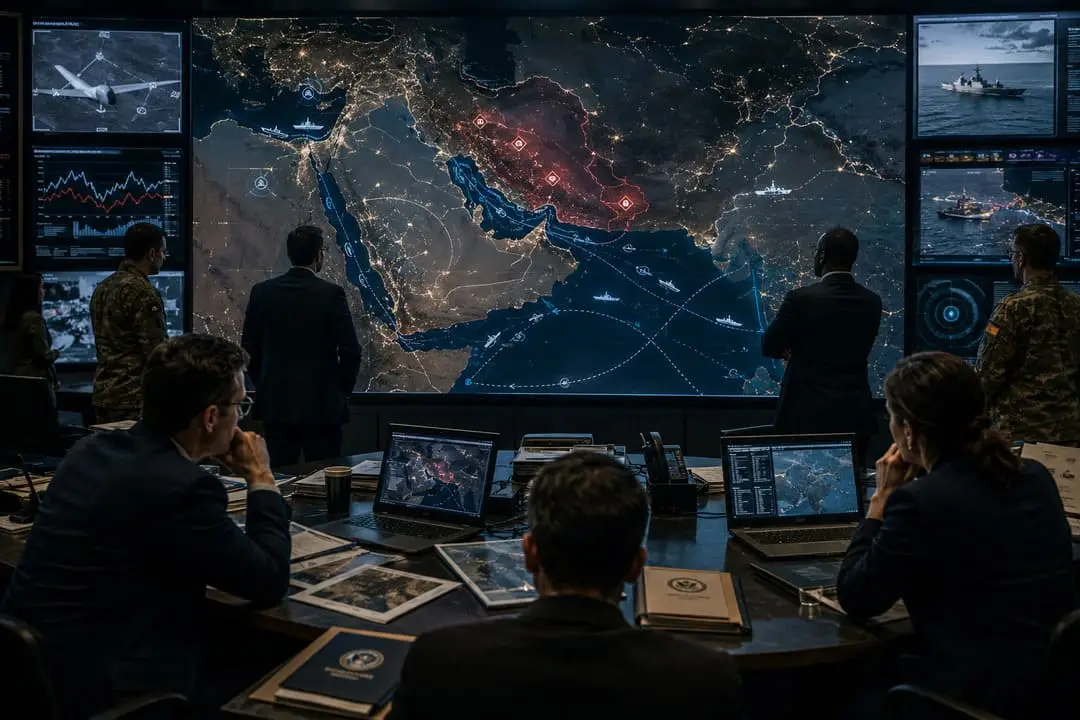
US strikes in Iran have become more than another military flashpoint. They now sit at the center of a fragile contest over diplomacy, deterrence, Gulf security, and whether a conflict that leaders keep describing as contained is quietly becoming harder to control.
The latest American strikes targeted Iranian radar and drone command infrastructure after U.S. officials said Iranian actions threatened American assets and regional shipping. That framing matters because Washington is trying to draw a narrow line: the strikes are meant to punish and deter, not formally widen the war.
The problem is that military restraint is not judged only by the country launching the strike. Iran, Gulf governments, oil markets, shipping operators, and U.S. allies all read the same event through different risks. A limited strike can still create an unlimited political reaction.
That tension explains why Trump’s delayed Iran attack still matters to understanding this moment. The White House has been trying to preserve room for negotiation while proving it will answer threats against U.S. forces, but every new exchange makes that balance harder to maintain.
US Strikes in Iran Are Testing The Line Between Deterrence And Escalation
The central question is not whether the United States can hit Iranian military targets. It can. The more important question is whether each strike still produces deterrence, or whether it teaches both sides to absorb limited attacks as the new normal.
That is the real danger in this phase. Once strikes become routine, restraint becomes harder to recognize. A radar site, drone control station, missile launcher, or air defense node may look tactical on a target list, but it can carry strategic weight if Tehran sees it as humiliation or if Washington sees Iran’s response as a test of American credibility.
For readers tracking the official military language, U.S. Central Command’s public release frames the operation as measured self-defense during an ongoing ceasefire. That wording is deliberate. It signals that Washington wants to defend troops and maritime movement without declaring that the broader diplomatic track is dead.
But military messaging cannot fully control political meaning. Iran can portray the same strikes as a ceasefire violation. U.S. critics can argue that the administration is drifting toward open-ended conflict. Allies can support the defense of American forces while privately worrying about the absence of a clear endgame. That is the pressure inside this moment: limited force, wider consequences.
The Peace Track Is Now Operating Under Fire
Diplomacy usually needs quiet space, predictable channels, and enough political trust for both sides to sell compromise at home. The U.S.-Iran track has almost none of that right now.
The talks are being strained by overlapping disputes: military attacks, maritime threats, nuclear concerns, sanctions pressure, Iranian demands, U.S. domestic politics, and Israeli operations elsewhere in the region. Even if negotiators remain technically engaged, the environment around them is deteriorating.
That matters because the public often imagines diplomacy and military action as separate lanes. In reality, they are constantly shaping each other. A strike can strengthen a negotiating hand if the other side believes more pain is coming. It can also destroy a negotiating hand if the other side concludes that compromise will be punished domestically as surrender.
For Washington, the gamble is that force can keep Iran from using drones, missiles, or maritime disruption as leverage. For Tehran, the counter-gamble is that pressure on regional shipping and U.S. positions can force concessions. Both strategies carry the same risk: diplomacy under fire can quickly become diplomacy for appearance only.
The Strait Of Hormuz Remains The Pressure Point No One Can Ignore
The Strait of Hormuz is not just geography. It is the crisis amplifier.
Whenever U.S.-Iran tensions rise near Gulf shipping lanes, the consequences travel far beyond the region. Energy traders react. Insurers reassess risk. Commercial shipping faces cost and routing questions. Gulf governments must manage security fears while avoiding steps that make them direct participants in a wider conflict.
That is why strikes connected to drones, radar, air defenses, or coastal military infrastructure draw such attention. They are not isolated military details. They sit close to one of the world’s most sensitive maritime corridors.
The nuclear dimension adds another layer. The broader dispute over Iran’s nuclear program has never disappeared, and readers trying to understand that backdrop can review the International Atomic Energy Agency’s dedicated page on monitoring and verification in Iran. The military crisis and nuclear question are not identical, but they feed the same strategic mistrust.
| Pressure Point | Why It Matters | Risk To Monitor |
|---|---|---|
| U.S. force protection | Washington must defend personnel and assets | More strikes after new Iranian attacks |
| Iranian retaliation | Tehran needs to show it has not been deterred | Missile, drone, or proxy activity |
| Maritime security | Gulf shipping affects global energy confidence | Insurance spikes or shipping disruption |
| Nuclear diplomacy | Any deal needs political space to survive | Talks pause, narrow, or collapse |
| Allied coordination | Gulf and Western partners need predictability | Mixed signals or public fractures |
The table shows why this is not a single-issue crisis. The strikes matter because they connect military defense, oil-market psychology, nuclear diplomacy, and regional alliance management in one combustible package.
The Misunderstood Risk Is Not One Big Decision
The most dangerous assumption is that escalation would arrive as one dramatic presidential order or one unmistakable Iranian attack. More often, regional crises worsen through accumulation.
A drone incident here. A missile interception there. A retaliatory strike described as defensive. A negotiating session postponed. A warning from Tehran. A reassurance from Washington. None of these alone has to trigger a wider war. Together, they can create a system where each side feels boxed in by its last move.
That is why the new U.S. strikes deserve serious attention even if they remain limited. They show that the ceasefire framework, if it still exists in practical terms, is operating under severe stress. A ceasefire that requires repeated military enforcement may still reduce violence, but it no longer creates much confidence.
The political risk for Washington is also real. If the administration appears too restrained, critics may accuse it of letting Iran set the pace. If it appears too aggressive, critics may argue that the U.S. is sliding into another Middle East conflict without a clear threshold for success. That leaves little room for error.
The Next Signals Will Matter More Than The Strike Itself
The next phase will be shaped less by the fact that the U.S. struck Iranian sites and more by what each side does after the strike.
The first signal is Iran’s response. A symbolic response may keep the confrontation contained. A direct attack on U.S. personnel, Gulf infrastructure, or commercial shipping would force a more serious American decision.
The second signal is whether indirect talks resume with substance or merely continue as diplomatic theater. If both sides keep exchanging proposals while their militaries exchange fire, the process may become a placeholder rather than a path.
The third signal is oil and shipping behavior. Markets do not need a full blockade to panic. They need uncertainty, rising insurance costs, credible threats, and enough disruption to make traders price in fear. That makes the Strait of Hormuz a maritime pressure point even when ships are still moving.
The fourth signal is allied alignment. If Gulf states, European governments, and U.S. security partners begin speaking with noticeably different priorities, the pressure on Washington’s strategy will increase. Military power can act quickly, but coalition confidence is slower to rebuild once it cracks.
The latest US strikes in Iran should be understood as a warning about the shrinking space between military pressure and diplomatic failure. Washington may still believe it can defend its forces, preserve leverage, and keep negotiations alive, but that formula gets weaker every time a limited strike becomes the next step in a longer chain. The decisive question now is whether the strikes restore control — or confirm that control is already slipping.


