

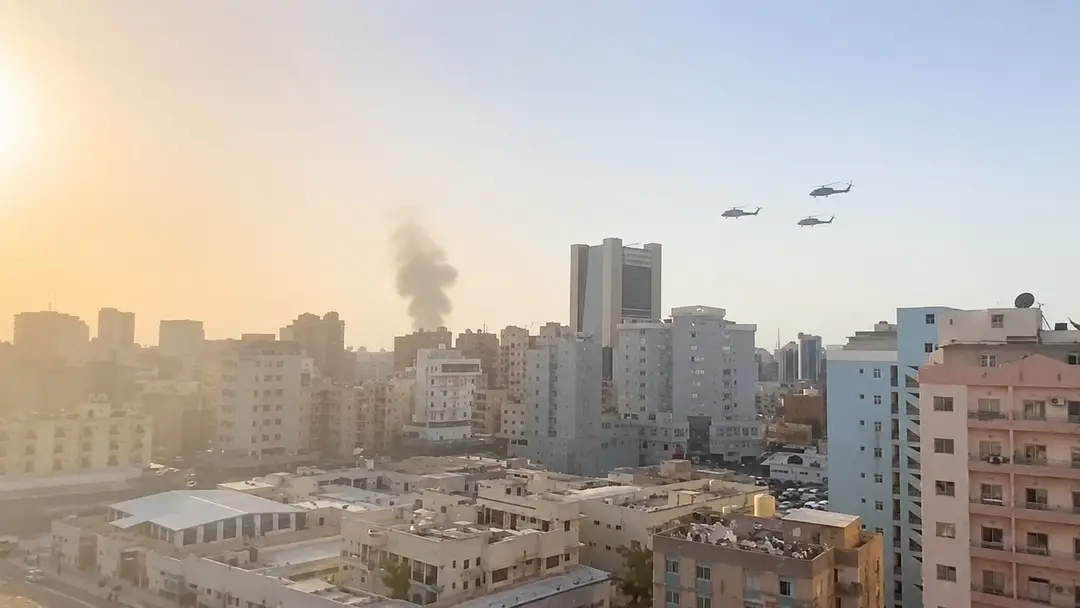
Iran attacks US bases at a moment when the Trump administration is trying to prove it can punish Tehran without losing control of a wider regional war. The danger is not only the immediate exchange of missiles and drones; it is the way each strike pulls more territory, more allies and more political risk into the conflict.
The latest escalation followed renewed American strikes on Iranian military targets near the Strait of Hormuz after Washington blamed Iran for the downing of a U.S. Apache helicopter. Iran then targeted U.S. positions in Bahrain, Kuwait and Jordan, turning a bilateral confrontation into a direct test for America’s regional security network.
That regional network was already under pressure after earlier U.S. action against Iran, a pattern examined in the broader Iran strikes debate. What makes this round more dangerous is that the retaliation reached across multiple U.S.-aligned territories, forcing Gulf partners and Jordan to absorb the consequences of Washington’s
confrontation with Tehran.
Trump’s Strike Strategy Faces A Harder Test
Trump’s approach rests on a familiar calculation: force Iran to understand that delay, defiance or escalation will carry a cost. That may work as a message, but it becomes harder to manage once Iran answers by threatening American personnel and partner territory.
The U.S. can hit Iranian air defenses, radar positions and command sites. The harder task is making those strikes reduce Tehran’s appetite for escalation rather than expand it.
A Reuters report on the exchange described Iranian missile and drone attacks on U.S. facilities after American strikes near Hormuz, with U.S. officials saying there were no significant casualties or damage.
That distinction matters. Limited damage does not mean limited consequence. Even intercepted attacks force military alerts, diplomatic calls, public reassurances and new calculations inside every allied capital involved.
Iran Attacks US Bases And Broadens The Crisis
Iran’s strikes on U.S. military sites in Bahrain, Kuwait and Jordan were not just a military response. They were a political message aimed at the infrastructure behind American power in the Middle East.
For Tehran, the point was to show that renewed U.S. strikes would not remain cost-free. For Washington, the challenge is to respond without allowing Iran to decide where the next front opens.
Bahrain, Kuwait and Jordan matter because they sit inside a wider U.S. defense architecture. Bases, radar systems, air corridors, naval facilities and host-government cooperation all help Washington project force across the region. When Iran targets that architecture, the pressure spreads beyond the original strike zone.
The battlefield is no longer limited to Iranian targets and American retaliation. It now includes the countries that house, support or sit near U.S. military power.
Gulf Allies Are Now Part Of The Pressure Point
The strikes put U.S. partners in an uncomfortable position. Cooperation with Washington provides deterrence, intelligence and defense support. It also makes host countries more exposed when Tehran decides to retaliate against the American presence rather than only American forces at sea.
Bahrain is especially sensitive because of its U.S. naval role. Kuwait has long been central to American military positioning in the Gulf. Jordan is not a Gulf state, but its inclusion shows how quickly the crisis can spill into the broader U.S. regional map.
| Location | Strategic Role | Main Risk |
|---|---|---|
| Bahrain | U.S. naval presence and Gulf security coordination | Naval escalation and public pressure |
| Kuwait | Key U.S. military partner in the Gulf | Air defense strain and regional exposure |
| Jordan | U.S. security partner near multiple conflict zones | Spillover beyond the Gulf |
| Strait of Hormuz | Critical shipping and energy corridor | Global oil, freight and insurance pressure |
These governments now have to speak to Washington, manage the risk from Tehran and reassure their own publics. That balance becomes harder each time missiles or drones enter their airspace.
The Political Damage Can Outlast The Physical Damage
Early accounts indicated that many Iranian projectiles were intercepted or failed to cause major damage. Operationally, that gives Washington and its partners room to argue that defenses worked. Politically, the image is more complicated.
A base does not need to be destroyed for the crisis to change. Alerts, interceptions and claims of retaliation can reset expectations. What looked like a rare escalation can become part of a new pattern.
The real danger is repetition. A drone strike, a missile launch, a targeted U.S. response and another Iranian warning can build momentum without either side formally choosing a larger war.
That is how regional crises often become harder to contain. Each actor insists it is responding defensively. Each move is framed as proportional. Yet the chain gets longer, and the space for restraint gets smaller.
Diplomacy Is Being Tested Under Fire
The diplomatic track is still relevant, but it is no longer operating in calm conditions. Mediation efforts and negotiation channels may continue, but every strike changes what leaders can accept publicly.
An AP report on the escalation framed the exchange as a serious threat to efforts to halt the war, with the renewed violence complicating talks between Washington and Tehran.
Iran cannot easily negotiate while appearing to absorb U.S. strikes without answer. Trump cannot easily negotiate while Iran targets U.S. bases. Gulf allies cannot indefinitely host the risk while pretending the conflict remains distant.
Diplomacy under fire becomes fragile because every concession starts to look like weakness. That is the political trap now forming around both governments.
The Next Signals Will Show Whether This Stays Contained
The first signal to watch is whether Iran repeats attacks on U.S. facilities or treats this as a bounded retaliation. A one-round response followed by back-channel talks would suggest controlled escalation. Repeated strikes would point toward a campaign against America’s regional footprint.
The second signal is target selection. Military sites keep the confrontation inside a dangerous but recognizable frame. Strikes near civilian airports, ports, energy infrastructure or commercial shipping would widen the crisis quickly.
The third signal is the Strait of Hormuz. Any sustained disruption near that corridor would turn a military standoff into an economic shock watched by oil markets, insurers and governments far beyond the Middle East.
Iran attacks US bases because Tehran wants the cost of American strikes to be felt across Washington’s regional system. Trump’s challenge is to answer without letting Iran choose the tempo, the geography or the political cost of the next phase. The crisis now turns on whether deterrence can be restored before retaliation becomes routine.


